I Read 60 Applications This Week. They Were All the Same Person.

Hazel Hernandez


May 15, 2026

6 min read
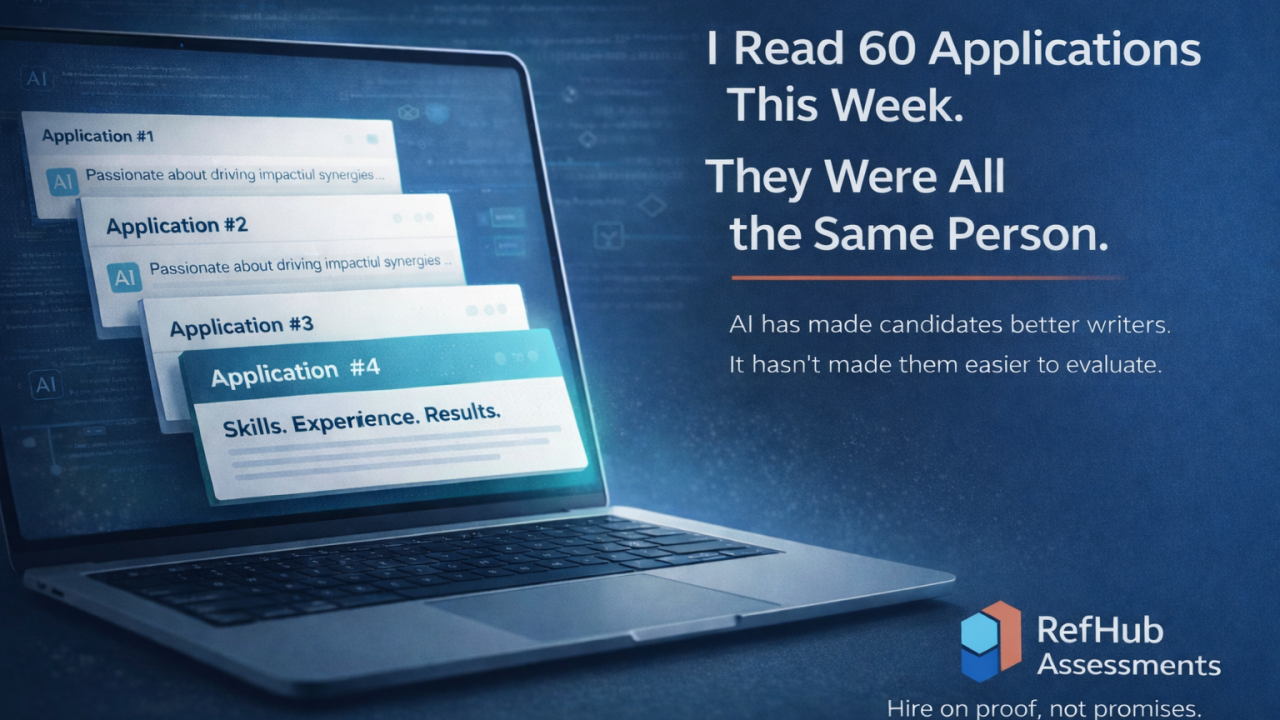
There's a new candidate in your inbox. They're passionate about driving impactful synergies in a collaborative, fast-paced environment. They thrive on challenges and are excited to bring their authentic self to a role where they can make a real difference.
Sound familiar?
Of course it does. You've read this person 47 times today.
Welcome to 2026, where every cover letter, every LinkedIn summary, and every candidate email has been lovingly polished by the same large language model into a smooth, confident, completely indistinguishable orb of professional competence.
It's not anyone's fault, really. Candidates are doing exactly what we'd all do: using every tool available to put their best foot forward. The problem is that everyone's best foot now looks identical. Same shoe. Same size. Perfectly formatted.
The recruiter's new nightmare
Hiring used to be hard because you had too little information. Now it's hard because you have too much - and almost none of it is signal.
A brilliantly written application tells you someone is good at prompting AI, or has a friend who writes well, or spent three hours on Sunday making their cover letter sound like a TED Talk. It does not tell you whether they can actually do the job.
The tone has been laundered. The rough edges, the ones that would have told you something real - have been smoothed away.
So how do you find the actual talent hiding inside the homogenised haystack?

This is exactly what Ref Hub assessments are for
At Ref Hub, we've always believed that the best signal on a candidate comes from people who've actually worked with them. References done properly - not the perfunctory "yes they were punctual" checkbox, but structured, insightful, skill-mapped feedback from real colleagues are extraordinarily hard to fake.
But we also know that assessments give candidates a chance to show rather than describe. And showing, unlike telling, is much harder to outsource.
Our assessments feature is built for exactly this moment. When every application sounds like it was written by the same confident ghost, assessments cut through the noise by asking candidates to demonstrate real capability in context - the kind of thing that can't be dressed up in em-dashes and power verbs.
It's the difference between someone saying they're "data-driven" (everyone is data-driven) and someone actually working through a problem in front of you.
The irony isn't lost on us
We're aware that "find the authentic candidates" is itself a phrase that's been polished to a mirror sheen by marketing teams everywhere. So let's be blunt about what this actually is:
It's a practical tool for a practical problem. Screening is broken because the inputs are broken. Assessments give you a new input, one that's harder to game, easier to compare, and actually correlated with how someone performs on the job.
Less vibe. More evidence.
The candidates who stand out right now
Here's the quietly interesting thing: in a world where everyone sounds the same, the candidates who don't try to sound perfect are starting to stand out again. The slightly clunky email that's clearly genuine. The application that admits a gap instead of spinning it. The person who, given the chance to demonstrate their thinking, just... does it, rather than describing how they'd do it.
Assessments create that space. And for the recruiters willing to look past the polished surface, there's genuinely great talent waiting there, it's just been wearing the same outfit as everyone else.
Time to look a little deeper.
-Hazel Hernandez, Ref Hub Business Operations & Client Success Specialist.
Related Articles


English (United Kingdom)